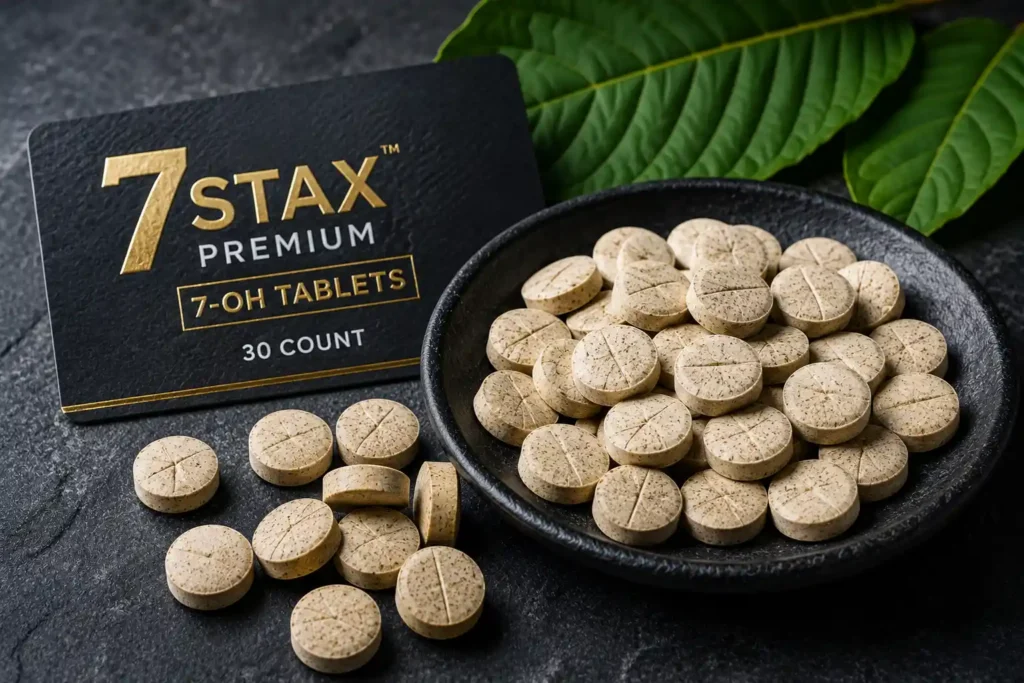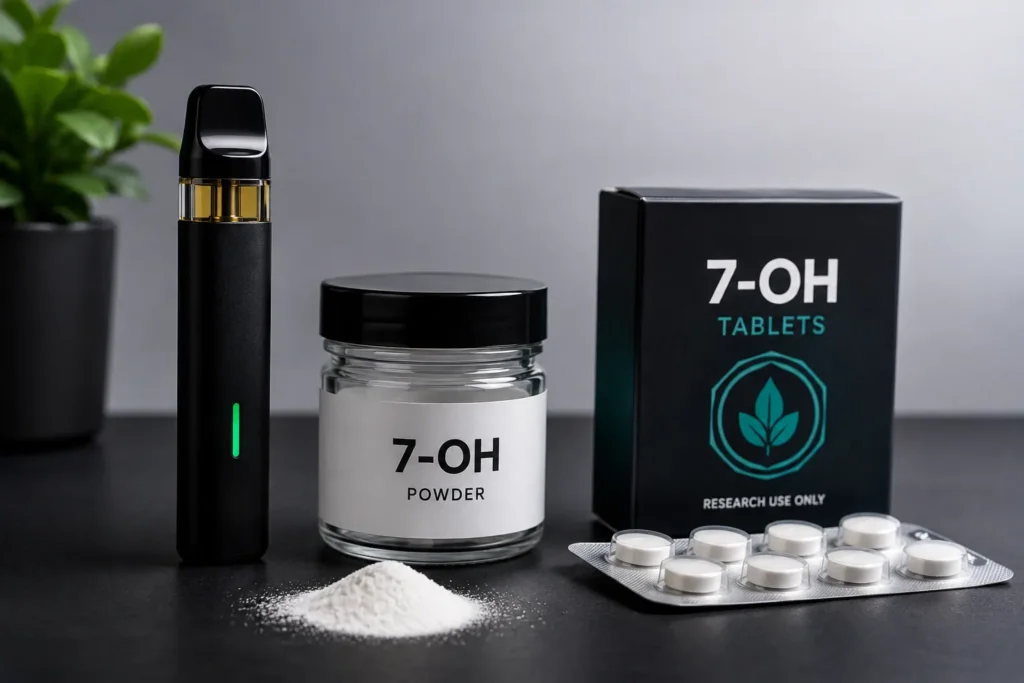
The phrase kratom in vapes can describe several different types of products, and that makes the category easy to misunderstand. Some products marketed around kratom contain botanical extracts, while others contain concentrated 7-hydroxymitragynine (7-OH) or other kratom-derived compounds.
7-OH products are also sold in different formats, including disposable vapes, tablets, extracts, gummies, shots, and other formulations. The format alone does not establish what the product contains, how much 7-OH it contains, or whether it is legal in a particular location.
What Is 7-OH?
7-OH is short for 7-hydroxymitragynine, an alkaloid associated with the kratom plant (Mitragyna speciosa).
Natural kratom contains multiple alkaloids. However, concentrated 7-OH products are different from ordinary kratom leaf because they can contain substantially enhanced levels of the compound.
This distinction matters when researching products described as 7-OH vapes, 7-OH tablets, or simply “kratom vapes.”
What Does “Kratom in Vapes” Mean?
“Kratom in vapes” is a broad consumer term rather than a precise chemical description.
A product marketed this way may contain kratom-derived material, 7-OH, another kratom-derived alkaloid, or a combination of ingredients. Some products may also contain additional botanical or cannabinoid ingredients.
For that reason, the product name should not be treated as a substitute for an ingredient declaration or laboratory documentation.
A useful product evaluation starts with:
- The complete ingredient list
- The stated active compounds
- The amount or concentration per product
- Batch or lot information
- A current Certificate of Analysis, when available
- The laboratory that performed the testing
- Applicable regulatory information
7-OH Vapes vs. 7-OH Tablets
The biggest difference between these products is their route of administration and formulation, rather than simply the name printed on the package.
7-OH Disposable Vapes
A 7-OH disposable vape is generally marketed as a ready-to-use inhalation device containing a formulation associated with 7-OH or another kratom-derived compound.
The important point is that inhalation introduces additional questions that do not apply in exactly the same way to an oral tablet. Researchers have raised concerns about aerosol composition, possible thermal degradation products, contaminants, and the lack of adequate data on the pulmonary effects of vaping kratom-derived compounds.
A 2026 review specifically identified vaping of kratom and 7-OH as an area where the composition, delivered exposure, and potential respiratory effects require further investigation.
7-OH Tablets
7-OH tablets are oral products designed to contain a measured quantity of a formulation associated with 7-OH.
Unlike a vape, the product is swallowed or otherwise administered orally depending on its labeling. However, a tablet should not automatically be assumed to be safer simply because it is not inhaled.
The FDA has warned consumers about concentrated 7-OH products and states that 7-OH products have not been proven safe or effective for any use.
Stack’d 7 OH Vape and Other Brand Names
Searches for terms such as “Stackd 7OH vape,” “Stack’d 7 OH vape,” and “7 O Heaven Kratom” generally indicate interest in particular branded products.
Brand terminology can be useful for finding a product, but it does not by itself establish its chemical composition or testing status.
For any specific product, readers should check the current packaging and supporting documentation rather than assuming that two products with similar names contain the same ingredients.
If a product claims to contain a particular amount of 7-OH, that claim should ideally be supported by batch-specific laboratory documentation.
What Does 7-OH Feel Like?
People searching “what does 7-OH feel like?” are usually looking for descriptions of the subjective effects associated with 7-hydroxymitragynine.
Those effects should not be presented as predictable or medically established outcomes. Individual responses can vary, and the available evidence does not establish a standardized experience across different products.
The FDA has reported adverse effects associated with 7-OH products, including dependence, withdrawal symptoms, gastrointestinal distress, insomnia, anxiety, depression, and seizures.
For that reason, descriptions such as “relaxing,” “energizing,” or “euphoric” should not be presented as guaranteed effects or as evidence of a therapeutic benefit.
How Can You Tell What Is Actually in a 7-OH Product?
Packaging can provide useful information, but it is not enough to establish product composition by itself.
When evaluating a product, look for documentation that connects the stated ingredients to a specific production batch. A useful COA should identify the tested sample or batch and provide the analytical results rather than simply displaying a generic laboratory logo.
Be particularly cautious about unsupported claims involving:
- Exact potency
- Purity
- “Pharmaceutical grade” status
- Medical benefits
- Regulatory approval
- Clinical effectiveness
- Guaranteed effects
None of these claims should be published without appropriate evidence.
Safety and Regulatory Considerations
7-OH products are currently subject to significant regulatory scrutiny in the United States.
The FDA states that concentrated 7-OH products have not been proven safe or effective for any use and recommends that consumers avoid products containing 7-OH. The agency also states that there are no FDA-approved products containing 7-OH.
The regulatory position is continuing to develop. In July 2026, the DEA announced an intent to temporarily place 7-OH above a proposed threshold, along with three related substances, into Schedule I under the Controlled Substances Act.
Rules can also differ between individual U.S. states and between the United States and the United Kingdom. Product availability therefore should not be interpreted as evidence that a product is lawful everywhere.
Why Testing and Transparency Matter
Testing is particularly important in a category where products can contain concentrated or chemically modified kratom-derived compounds.
A transparent product page should provide only information that can actually be verified. If a batch has been tested, the relevant documentation should correspond to that batch rather than being presented as generic evidence for every product.
For Alkaloid Hub, this means product descriptions should be updated whenever formulations, laboratory results, labeling, or applicable regulations change.
Frequently Asked Questions
Is kratom in vapes the same as traditional kratom?
Not necessarily. “Kratom in vapes” is a broad marketing or search term, and products can contain different kratom-derived compounds or formulations.
Are 7-OH vapes the same as 7-OH tablets?
No. They may involve the same named compound but use different delivery formats. A vape involves inhalation, while a tablet is generally an oral formulation.
What is a 7-OH disposable vape?
It is a disposable vaping product marketed as containing 7-hydroxymitragynine or a related kratom-derived formulation. The actual ingredients and concentrations should be verified from the product documentation.
What is 7-OH?
7-OH is the common abbreviation for 7-hydroxymitragynine, an alkaloid associated with kratom.
Does “kratom vape” mean the product contains only kratom?
No. The term does not establish the complete formulation. Products should be evaluated using their ingredient declarations and, where available, batch-specific laboratory testing.
Are 7-OH products FDA approved?
No. The FDA states that there are no FDA-approved products containing 7-OH and warns consumers about concentrated 7-OH products.
Compliance Notice
This information is provided for educational purposes and is not medical advice.
7-OH products are not FDA-approved medicines, and Alkaloid Hub does not represent them as treatments for medical conditions or as products with established therapeutic benefits.
Regulatory requirements can vary by jurisdiction and can change over time. Customers and businesses should verify the current laws applicable to their location before purchasing, possessing, distributing, or otherwise handling products containing 7-OH or other regulated kratom-derived compounds.