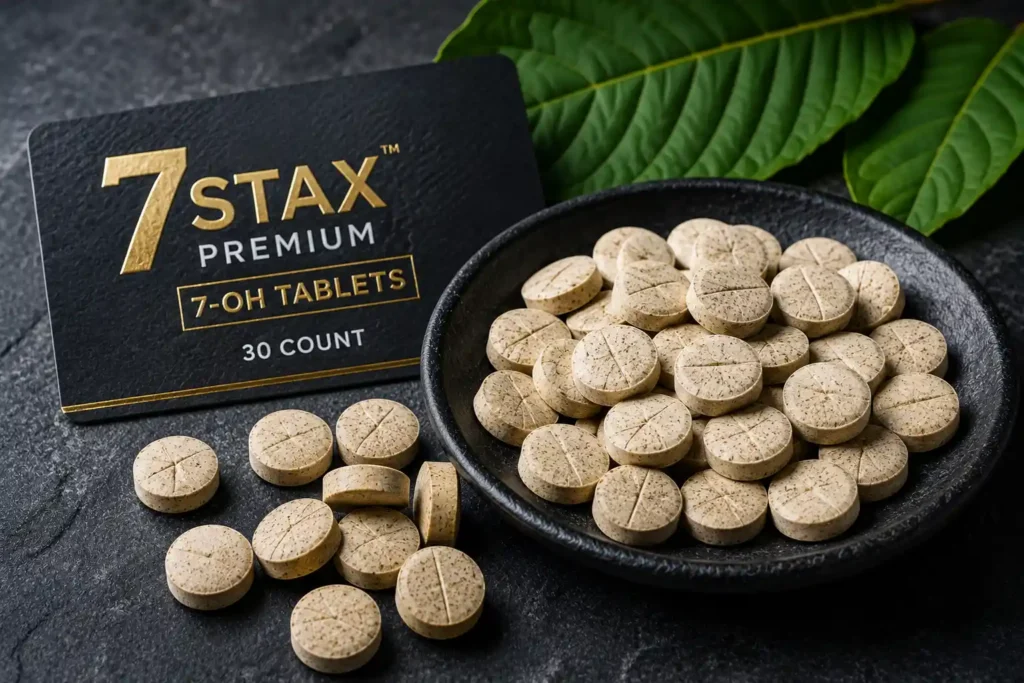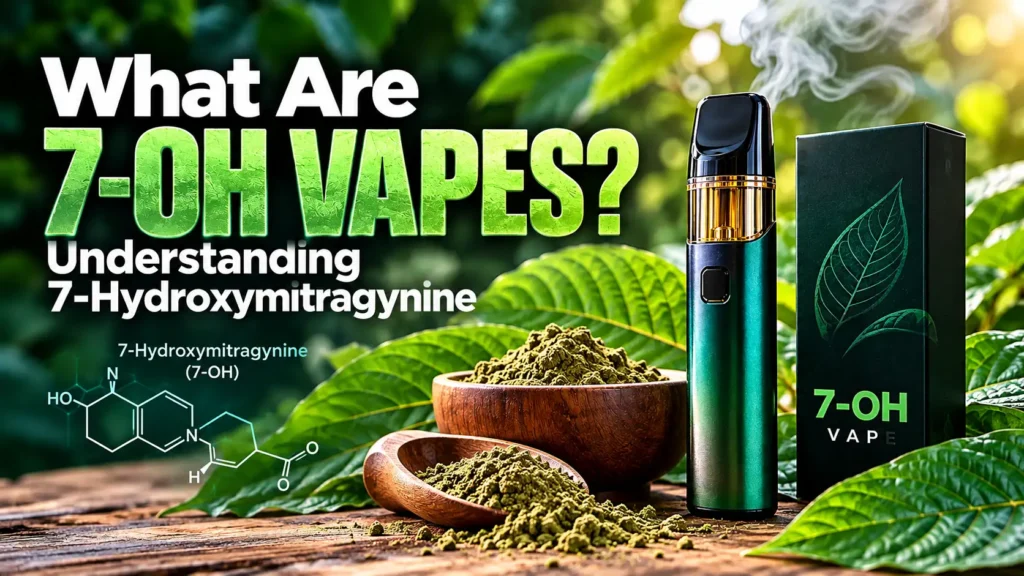
Searches such as buy 7oh powder online, 7-oh vape for sale, and 7 oh vape near me reflect the growing visibility of concentrated 7-hydroxymitragynine products. These products are commonly marketed in forms that include powders, tablets, shots, gummies, and vaping products.
However, the name alone does not tell you what a product contains, how concentrated it is, or whether it is legal where you live. That distinction has become particularly important as regulators and researchers have increased their attention to concentrated 7-OH products.
The FDA describes 7-hydroxymitragynine, commonly shortened to 7-OH, as a potent opioid compound that occurs naturally in kratom in trace amounts. The agency’s concerns are focused particularly on products containing added or enhanced concentrations of 7-OH rather than ordinary botanical kratom containing only naturally occurring trace levels.
This article explains the terminology surrounding 7-OH powders, vapes, and tablets, while also examining product labeling, laboratory testing, safety concerns, and the changing regulatory landscape.
What Is 7-OH?
7-hydroxymitragynine is one of the alkaloids associated with Mitragyna speciosa, commonly known as kratom.
In naturally occurring kratom leaf, 7-OH is present in relatively small amounts. Concentrated commercial products are different because they can contain substantially elevated levels of the compound.
7-OH has attracted scientific attention because of its activity at opioid receptors. The FDA considers concentrated 7-OH products to be novel potent opioid products and states that there are currently no FDA-approved products containing 7-OH.
This is an important distinction when reading online product descriptions. A product being described as “kratom,” “botanical,” or “natural” does not necessarily mean that it has the same chemical profile as unprocessed kratom leaf.
Why Are People Searching for 7-OH Products Online?
Search behavior around 7-OH has expanded alongside the appearance of new product formats.
Consumers may encounter terms such as:
- 7-OH powder
- 7-OH tablets
- 7-OH vapes
- 7-OH shots
- Dollar Tabs
- 7-OH extracts
- concentrated kratom products
The terminology can be confusing because there is no universal commercial standard associated with names such as Dollar Tabs or 7-OH vape.
Two products with similar names can have different ingredients, concentrations, manufacturing processes, and laboratory results.
For that reason, the product name should be treated as a starting point for investigation rather than proof of what is actually contained in a product.
7 OH Vape Near Me: What Does the Term Mean?
The search phrase 7 oh vape near me generally indicates interest in locally available vaping products containing or marketed around 7-OH.
Vaping introduces an additional scientific question because the compound is being delivered through an aerosol rather than a conventional oral product.
A 2026 article in Toxicological Sciences identified 7-OH and kratom vaping products as an emerging public-health concern. The researchers highlighted unanswered questions involving aerosol exposure, altered pharmacokinetics and pharmacodynamics, potential thermal degradation products, and respiratory toxicity.
Importantly, the existence of these concerns does not mean that every 7-OH vaping product has the same composition or produces the same exposure. Instead, it highlights how limited the evidence remains.
There is currently insufficient research to establish the long-term respiratory effects of inhaling 7-OH-containing aerosols.
7 OH Powder for Sale: Why Product Identity Matters
The phrase 7 oh powder for sale can refer to several different types of products.
A powder may be presented as an isolated compound, a concentrated extract, or a mixture containing several alkaloids. Without laboratory documentation, the product description alone may not establish its chemical identity or concentration.
This is especially relevant because concentrated 7-OH products can differ substantially from traditional botanical kratom.
The DEA reported in 2026 that commercial products containing elevated or synthesized 7-OH were being sold in multiple forms, including powders, tablets, capsules, gummies, and dissolvable strips.
For researchers evaluating a powder, useful documentation includes the exact compound name, batch identification, analytical method, concentration measurement, and date of testing.
Dollar Tabs 7OH and 7OH Dollar Tabs
The phrases dollar tabs 7oh and 7oh dollar tabs generally describe tablet products associated with 7-OH and a low per-tablet price point.
“Dollar Tabs” is not a standardized scientific classification. It is primarily a commercial product name or pricing description.
That means the term does not establish:
- The amount of 7-OH present
- Whether the stated concentration is accurate
- Whether other alkaloids are present
- Whether the product contains synthetic or semi-synthetic material
- Whether the product has been independently tested
When comparing products described as Dollar Tabs, laboratory documentation is therefore considerably more informative than the product name.
7OH Tablets Dollar Tabs: Why Labels Matter
7OH tablets Dollar Tabs are part of a broader category of concentrated tablet products that have attracted regulatory attention.
One of the challenges with concentrated alkaloid products is the difference between a label claim and an independently measured concentration.
The FDA has previously reported enforcement actions involving 7-OH products and has also published recalls involving products in which laboratory testing found more 7-OH than the declared amount.
This does not mean that every product has inaccurate labeling. It does mean that consumers and researchers should avoid assuming that a printed number is equivalent to an independently verified analytical result.
A credible certificate of analysis should correspond to the specific batch being evaluated.
What Should a Certificate of Analysis Show?
A Certificate of Analysis, commonly called a COA, can provide useful information about the chemical composition of a particular batch.
Depending on the laboratory and testing method, relevant information may include:
- Product identification
- Batch or lot number
- Sample date
- Testing date
- 7-OH concentration
- Other alkaloid concentrations
- Analytical method
- Laboratory identification
- Detection limits
- Contaminant testing
A COA should also be interpreted carefully. A laboratory result confirms what was measured in a particular sample; it does not automatically establish that every unit from every production batch has the same composition.
For that reason, batch-specific testing is more useful than a generic laboratory report that cannot be connected to the product being evaluated.
7OH Delivery Near Me: Availability Is Not the Same as Legality
The search term “7oh delivery near me” focuses on availability, but availability and legality are separate questions.
A product appearing in an online search, marketplace, smoke shop, or convenience store does not necessarily mean that it is approved or lawful in a particular jurisdiction.
The regulatory situation in the United States has changed considerably during 2025 and 2026.
In July 2026, the DEA announced the start of a temporary scheduling process involving 7-OH above a specified threshold, as well as three related substances: mitragynine pseudoindoxyl, MGM-15, and MGM-16. The DEA stated that the action was directed toward concentrated or synthesized products and did not apply to botanical kratom containing naturally occurring 7-OH below the specified threshold.
Because regulations can change, information published several months ago may no longer accurately describe the legal status of a particular product.
Is 7-OH the Same as Traditional Kratom?
No.
Traditional kratom comes from the leaves of Mitragyna speciosa and contains a complex mixture of naturally occurring alkaloids. 7-OH is one component of that chemical profile and normally occurs at relatively low levels.
Concentrated 7-OH products can have a substantially different chemical profile.
The FDA has specifically emphasized this distinction, noting that its concerns focus on products containing added or enhanced 7-OH rather than naturally occurring trace amounts in botanical kratom.
This distinction is important because the terms “kratom” and 7-OH are sometimes used interchangeably in online marketing even though they can describe chemically different products.
Safety Questions Surrounding Concentrated 7-OH
The scientific evidence surrounding concentrated 7-OH products is still developing.
The FDA reports adverse events associated with 7-OH products, including addiction, anxiety, depression, gastrointestinal distress, insomnia, seizures, and withdrawal symptoms. The agency recommends that consumers avoid products containing 7-OH.
The concern becomes particularly relevant when products contain concentrated amounts of an opioid-active compound.
There is also limited information about long-term exposure to commercially manufactured 7-OH products. Different formulations can have different absorption characteristics, and vaping introduces additional questions that do not apply in the same way to oral tablets or powders.
As a result, claims that a particular format is inherently safer or more predictable should be treated cautiously unless supported by appropriate clinical evidence.
Common Misconceptions About 7-OH Products
“Natural” means the product is harmless
Not necessarily. A naturally occurring compound can still have significant pharmacological effects.
Every 7-OH product is the same
No. Products can differ in concentration, ingredients, formulation, and manufacturing process.
A product labeled “kratom” must contain only kratom leaf
Not necessarily. Concentrated or enhanced products can have chemical profiles that differ substantially from botanical leaf.
A COA proves a product is safe
No. A COA can provide analytical information about a sample, but it does not establish clinical safety or prove that a product is appropriate for human consumption.
Online availability means a product is legal
No. Legal status depends on the relevant jurisdiction, product composition, concentration, and applicable regulations.
What to Consider When Researching 7-OH Online
For people researching the category rather than simply looking at product names, several factors are more useful than price or marketing terminology.
1. Chemical identity
Determine exactly which compound is being described. “7-OH,” “kratom extract,” and “enhanced kratom” are not necessarily interchangeable terms.
2. Independent testing
Look for laboratory results that identify the actual batch and provide analytical measurements.
3. Full labeling
A product should have clear information about its ingredients and stated composition. Missing or vague information makes meaningful evaluation more difficult.
4. Regulatory status
Check the current laws and regulatory announcements applicable to the location where the product is being considered.
5. Evidence quality
Give greater weight to regulatory documents, peer-reviewed research, and laboratory analysis than unsupported claims found in advertisements or social-media posts.
The Future of 7-OH Products
The 7-OH market is changing quickly.
Regulators are paying closer attention to concentrated products, while researchers continue to investigate their chemistry, pharmacology, toxicology, and potential risks.
The FDA has described concentrated 7-OH products as a growing public-health concern, while the DEA’s 2026 action demonstrates that the regulatory framework is also evolving.
Research into vaping products is developing as well. The 2026 scientific literature has identified important unanswered questions about aerosol exposure and respiratory effects, demonstrating that there is still a significant gap between commercial availability and scientific understanding.
Final Thoughts
Searches for buy 7oh powder online, 7-oh vape for sale, 7 oh vape near me, and related terms such as 7oh dollar tabs, bkc dollar tabs, 7 oh powder for sale, and 7oh delivery near me reflect the expanding visibility of concentrated 7-OH products.
However, names such as Dollar Tabs describe commercial products rather than standardized scientific categories. The actual chemical composition, concentration, testing history, and regulatory status can vary considerably.
The most important distinction is between trace 7-OH naturally present in botanical kratom and concentrated products specifically formulated around elevated 7-OH levels. Current regulatory and scientific attention is focused heavily on the latter.