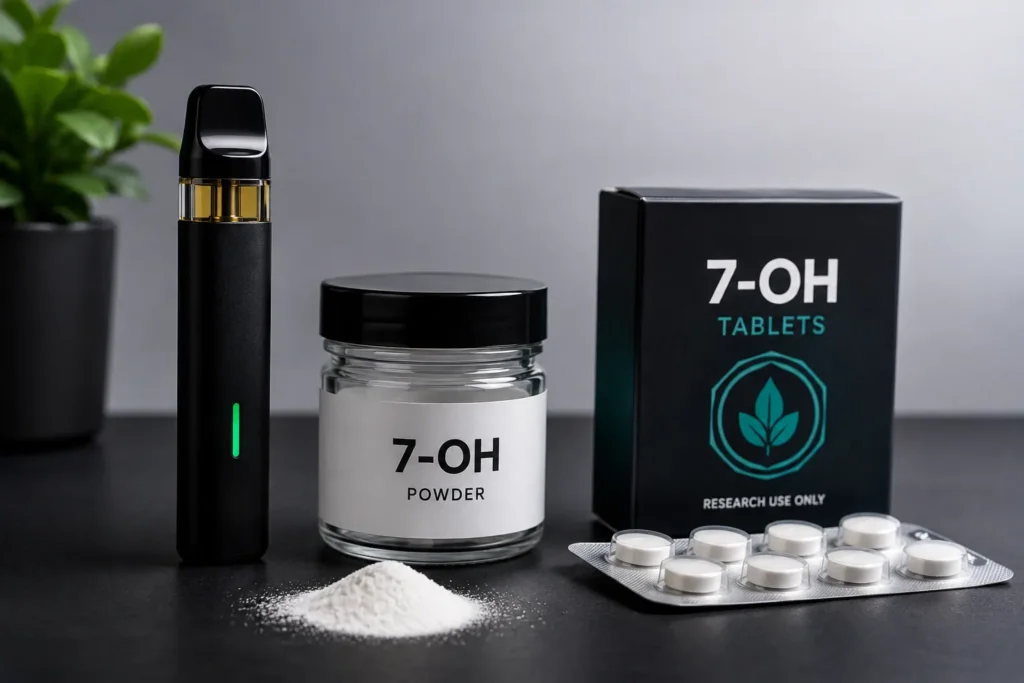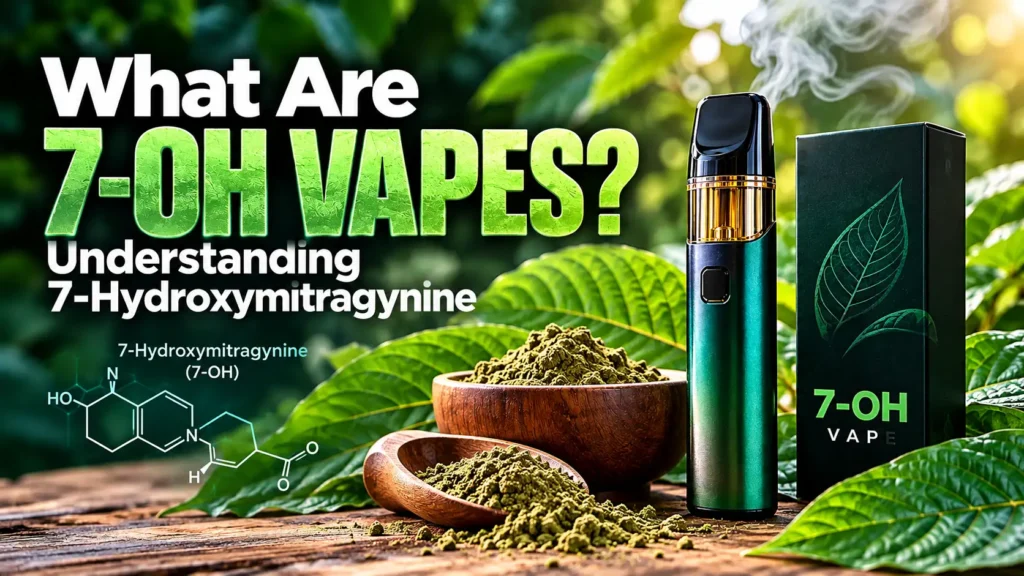
Products that are marketed as concentrated 7-hydroxymitragynine, usually referred to as 7-OH, have become more and more noticeable in conversations regarding kratom and new psychoactive substances. These products are available in various forms, including tablets, chewables, capsules, gummies, powders, and other preparations.
The product that draws attention is the 7 STAX Premium 7-OH Tablets 30 Count range. Searches for terms such as 80mg 7OH tablets, 7OH chewable tablets, and various brand names indicate growing interest in products containing concentrated 7-hydroxymitragynine.
Yet, to understand these products, it is necessary to look at neither the number of tablets in a package nor the quantity printed on the label.
The U.S. Food and Drug Administration has cautioned consumers regarding concentrated 7-OH products and says that 7-OH has not been approved for medical use; the FDA clearly differentiates between the small amounts of 7-OH that occur naturally in kratom and those found in products that have had the 7-OH added or enhanced.
Regulatory conditions are also changing rapidly. In July 2026, the Drug Enforcement Administration declared a procedure aimed at temporarily putting 7-OH above a proposed threshold and a number of synthetic-related compounds into Schedule I under federal law.
The article explains what the 7-OH tablets are, what the 80mg label indicates, why the product strength must be taken carefully, and how state regulations can influence availability and legality.
What Is 7-OH?
7-OH stands for 7-hydroxymitragynine, which is an alkaloid found in the kratom plant, Mitragyna speciosa.
Kratom that occurs in nature contains a number of alkaloids, one of which is mitragynine, and another, 7-hydroxymitragynine, which is found in it in much smaller quantities.
Things change when a 7-OH concentration is carried out or when it is added to a product.
The FDA has referred to concentrated 7-OH products as strong opioid agents and has cautioned that they have not been shown to be safe or effective for any medical purpose.
It is important to make this distinction since the term ‘kratom’ can be found on products that have very different chemical compositions.
One should not automatically consider traditional kratom leaf and a concentrated 7-OH tablet to be the same just because both of them are associated with Mitragyna speciosa.
Understanding 80mg 7OH Tablets
The tablets known as 80mg 7OH generally have a labeled total content of 80 milligrams of 7-hydroxymitragynine.
The figure is important because it shows the claimed amount of the active ingredient. It does not, by itself, prove the product’s actual concentration, purity, or safety.
For instance, a package with 30 tablets marked as 80mg each would have a completely different stated quantity than a product with a strength of 80mg throughout the whole package.
Consumers therefore need to distinguish between:
- Amount per tablet
- Amount per serving
- Total amount in the package
- Actual laboratory-measured concentration
- Declared concentration on the label
This distinction is especially important for concentrated 7-OH products, since the FDA has expressed concern that their contents may differ from what is stated on the labels.
In February 2026, the FDA published a recall involving chewable tablets that contained more 7-OH than declared. The recalled product was found to contain 7-OH above its labeled 7.5. This example shows that a printed number should not be taken automatically as meaning that the content has been confirmed in the laboratory. ory-confirmed content.
7STAX Premium 7-OH Tablets 30 Count
The product, known as 7STAX Premium 7-OH Tablets 30 Count, includes 30 tablets and is marketed in connection with 7-OH.
Package count is only one factor to consider when assessing any product in this category.
An adequate evaluation must take into account the active ingredient as stated, the quantity per unit, the full list of ingredients, the lot information, and, if available, independent analytical documentation.
The chemical identity of a product is not determined by its name.
Just as ‘premium’ is a marketing term, not a quantitative measure, it says nothing about purity, potency, or safety.
For a product containing an active pharmacological substance like 7-OH, laboratory testing is far more important than relying on brand terminology.
How 7-OH Tablets Differ From Traditional Kratom
Traditional kratom products contain mitragynine, which occurs naturally, as well as smaller amounts of 7-hydroxymitragynine and other alkaloids.
The concentrated 7-OH products differ because they can have considerably higher 7-OH levels.
The FDA’s current consumer advice cautions people about products marketed as tablets, gummies, drink mixes, and shots that contain added or enhanced 7-OH.
That is one of the reasons why the expression “kratom product” should not be treated as if it refers to a single, uniform category.
Two products can carry similar branding while having substantially different chemical makeups.
The concentration of an active compound may also affect a product’s therapeutic profile. Consequently, evaluating traditional leaf products with concentrated 7-OH tablets solely on the basis of their shared botanical association can be misleading. Concentrated 7-OH is also available in chewable tablets.r Even though chewable products may look like regular supplements or other tablet products, their appearance does not show anything about how the active ingredient behaves pharmacologically.e how the active compound behaves pharmacologically.
The FDA has specifically noted that tablets and chewable products are among the forms in which concentrated 7-OH has occurred.
An important consideration is that the label should match the actual contents.
In 2026, the FDA released details regarding a recall affecting chewable tablets that contained more 7-OH than had been declared.
This shows the importance of independent testing and correctly labeling products in this category.
Pressd 7OH Tablets and Other Brand Searches
Requests for pressed 7OH tablets, 7STAX, and other branded 7-OH products often show people comparing products by brand, number of tablets, or stated strength.
Yet brand names alone are insufficient to determine whether two products have the same chemical constituents.
When comparing any 7-OH product, useful questions include:
Exactly what does the label state?
Find the amount of 7-OH per tablet or per serving, and determine whether that figure refers to a single tablet or the whole package.
Is the amount independently verified?
A certificate of analysis can provide information about testing, but its value depends on the laboratory, testing method, sample identification, and whether the report corresponds to the actual product lot.
Does the product contain other active substances?
Some products may contain multiple kratom alkaloids or other ingredients. A single headline number may therefore not tell the complete chemical story.
Is the product legally marketed in the relevant state?
State laws can differ substantially. A product being visible online does not establish that its possession, sale, or distribution is lawful where someone lives.
Omega 7OH Tablets and Similar Product Names
The search term omega 7OH tablets illustrates another challenge with emerging product categories: names can be difficult to interpret without verified product information.
A brand or product name does not necessarily describe a standardized pharmaceutical formulation.
The same general terminology may be used across products with different concentrations, ingredients, and testing practices.
For this reason, readers should avoid assuming that products sharing “7-OH” in their names are interchangeable.
The FDA has stated that concentrated 7-OH products have not been approved for medical use and recommends that consumers avoid these products.
7-OH Tablets in Ohio
Searches for 7OH tablets in Ohio require particular caution because the state has adopted specific restrictions on mitragynine-related compounds.
An Ohio administrative rule effective May 19, 2026, classifies specified mitragynine-related compounds as Schedule I controlled substances. The rule expressly includes 7-hydroxymitragynine and several related compounds.
This means Ohio should not be treated as a state where ordinary assumptions about the legal status of 7-OH products apply.
Anyone researching the possession or distribution of these products in Ohio should consult the current Ohio Administrative Code and seek qualified legal guidance rather than relying on an online product listing.
7-OH Tablets in Tennessee
The situation is even more significant for searches involving 7OH tablets in Tennessee.
Tennessee enacted legislation that took effect on July 1, 2026, and prohibits the possession, manufacture, delivery, and sale of kratom.
The law defines kratom broadly to include material from Mitragyna speciosa containing mitragynine or 7-hydroxymitragynine, along with synthetic equivalents and substances derived from the plant containing those compounds.
As a result, consumers should not assume that products associated with 7-OH can legally be purchased, possessed, or distributed in Tennessee simply because similar products may appear elsewhere.
7-OH Tablets in Mississippi
The legal environment surrounding 7OH tablets in Mississippi demands careful attention to current legislation and legislative updates.
The Federal Register’s 2026 discussion identified Mississippi as having a specific limit concerning 7-hydroxymitragynine in kratom products, including a one-percent alkaloid-fraction limit and a 0.5mg-per-container limitation under the state’s regulatory framework.
Mississippi legislation has also included proposals concerning the scheduling and regulation of kratom and 7-hydroxymitragynine.
Because legislation can change during a session, older articles should not be treated as conclusive evidence of current legality.
7-OH Tablets in Texas
State-level restrictions add to the complexity of searches for 7OH tablets in Texas.
The Federal Register’s July 2026 review identified Texas among states with restrictions concerning the amount of 7-hydroxymitragynine permitted in products.
That means a product’s labeled strength can be legally significant even when the same product is treated differently elsewhere.
Consumers should distinguish between federal developments, state restrictions, and local rules. These can operate independently.
7-OH Tablets in Michigan
Michigan has also been monitoring the growth of concentrated 7-OH products.
A Michigan Department of Health and Human Services bulletin published in March 2026 warned medical professionals about 7-OH-enhanced kratom products and described concerns involving exposures, interactions, and serious outcomes.
Michigan legislative proposals have also addressed kratom and synthetic variants, including synthetic 7-OH.
For anyone researching 7OH tablets in Michigan, the important takeaway is that the regulatory and public-health environment is changing and should be checked against current state information.
7-OH Tablets in Nevada
Interest in 7OH tablets in Nevada has also increased alongside wider discussions about kratom regulation.
Nevada’s Board of Pharmacy has been evaluating regulatory approaches involving mitragynine, 7-hydroxymitragynine, and related derivatives. A 2025–2026 annual report recommended considering these substances for Schedule I classification under Nevada’s controlled-substance regulations.
A recommendation or regulatory review should not automatically be interpreted as a completed legal prohibition. The exact status depends on the rulemaking process and effective dates.
This is a useful example of why legal information about 7-OH needs to be dated and jurisdiction-specific.
Federal Regulation of 7-OH in 2026
Federal regulation is another major consideration.
On July 1, 2026, the DEA announced its intent to temporarily schedule 7-OH above a proposed threshold and three synthetic-related compounds. The announcement followed an HHS determination concerning synthetic 7-OH and related substances.
The FDA separately stated that concentrated 7-OH products have not been approved for medical use and has taken enforcement action involving products containing concentrated 7-OH.
The regulatory process is therefore not simply theoretical. It has already involved federal warnings, product seizures, recalls, and proposed scheduling measures.
Anyone researching these products should check the current federal and state positions before assuming their legal status.
Are 80mg 7OH Tablets Safe?
There is no established FDA-approved medical dose for 7-OH products.
The FDA states that products containing 7-OH have not been proven safe or effective for any use and recommends that consumers avoid them.
An “80mg” label should therefore not be interpreted as a medically established dosage.
This distinction is especially important because 7-OH acts on opioid receptors. Concentrated products can have pharmacological effects that differ substantially from ordinary botanical kratom preparations.
Product consistency is also a concern. The 2026 FDA recall involving tablets with more 7-OH than declared demonstrates that labeled content and actual content can differ.
Final Thoughts
Growing search interest in 7STAX Premium 7-OH Tablets 30 Count, 80mg 7OH tablets, 7OH chewable tablets, and other branded products shows a rapidly changing market.
However, product names and package sizes do not provide enough information to determine chemical identity, purity, safety, or legality.
7-hydroxymitragynine is a pharmacologically active kratom-related alkaloid. Concentrated 7-OH products have received notable attention from the FDA because of safety concerns, while the DEA began a temporary federal scheduling process in 2026.
State laws add a further layer of complexity. Ohio and Tennessee have adopted particularly significant restrictions, while states such as Mississippi, Texas, Michigan, and Nevada have developed their own regulatory approaches or are actively considering changes.
For readers researching 7-OH tablets, the most responsible approach is to focus on verified product information, independent testing, current regulatory sources, and the distinction between traditional kratom and concentrated 7-OH products.
Most importantly, an 80mg label is a product claim, not evidence of an approved medical dosage. The FDA has not approved 7-OH products for medical use, and current federal and state regulatory developments make it especially important to verify the laws and safety information applicable to a specific location.