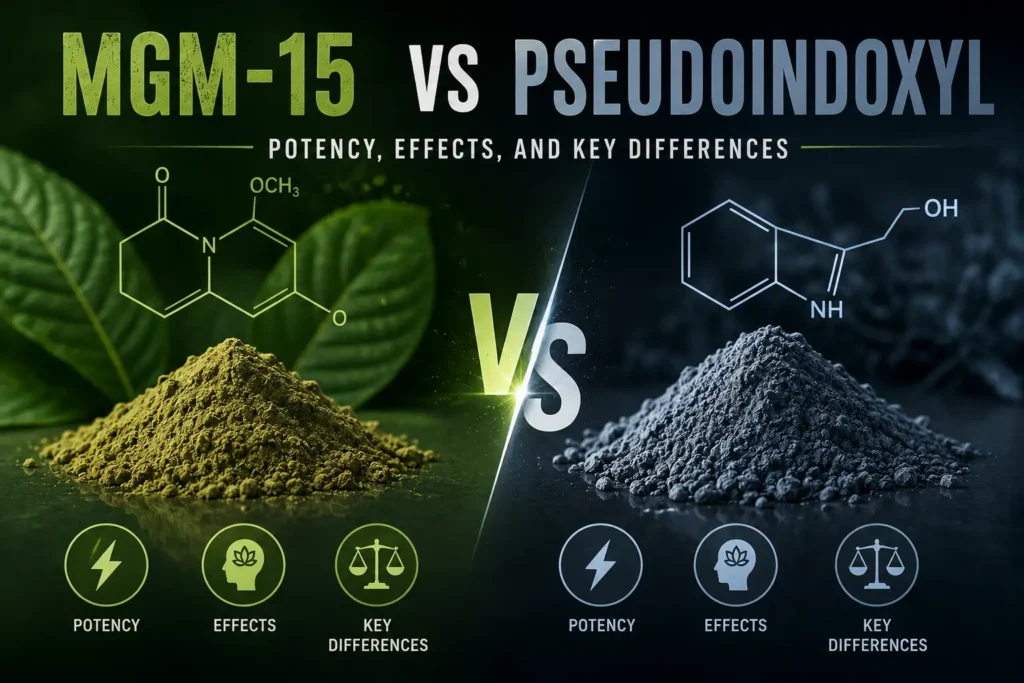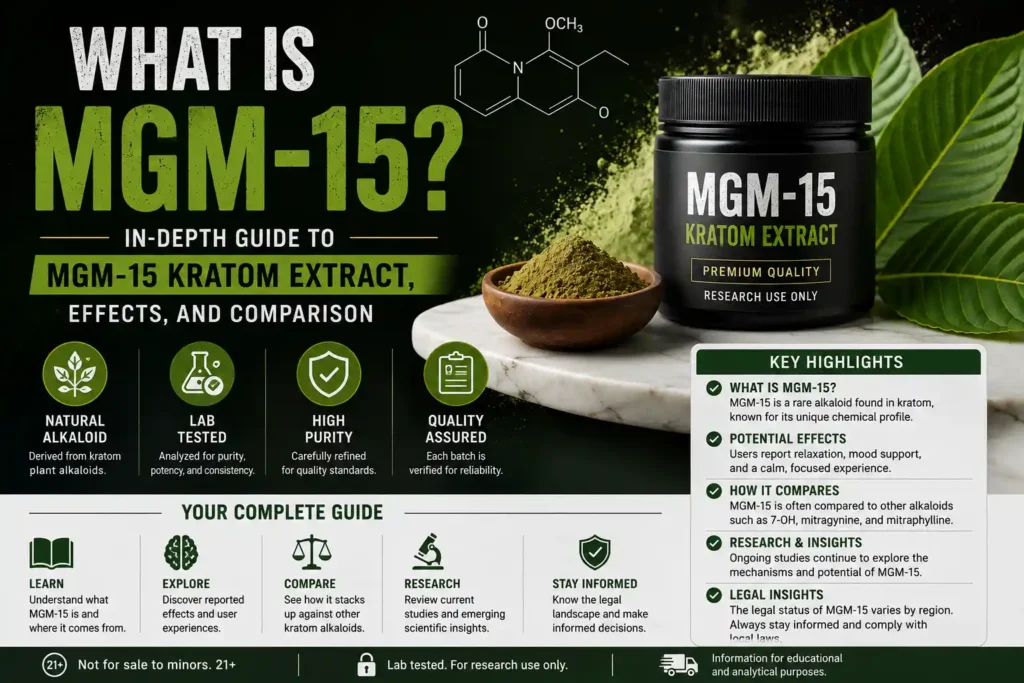
MGM-16 has recently become a topic of interest in conversations about kratom-derived compounds, 7-hydroxymitragynine, and newer semi-synthetic opioids. Even though more people are talking about it online, there is still a lot of confusion about what MGM-16 really is, whether it is found naturally in kratom, and whether products like MGM-16 extract, powder, or tablets are actually available to consumers.
Scientific research on MGM-16 is much more limited than many online sources suggest.
MGM-16 is a synthetic compound related to 7-hydroxymitragynine and mitragynine. Scientists first described it in medicinal chemistry research over ten years ago. Lab studies have looked at how it acts on opioid receptors and its effects in animals. However, these results are from early research and do not prove that MGM-16 is safe or effective for people.
This difference is important because some people talk about MGM-16 as if it were just another strong kratom alkaloid. That is not the case. MGM-16 is a chemically modified compound and does not occur naturally in the kratom plant. U.S. federal authorities have also listed MGM-16 as one of several synthetic substances related to 7-hydroxymitragynine that are being considered for temporary scheduling in 2026.
What Is MGM-16?
MGM-16 is a synthetic mitragynine-related compound developed through medicinal chemistry research. It is closely related to MGM-15 and is structurally derived from the same broader chemical framework associated with 7-hydroxymitragynine.
The compound is also described as 9-fluoro-dihydro-7-hydroxymitragynine. Some sources use alternative numbering conventions when describing the fluorine substitution. This can make different scientific descriptions appear to refer to different compounds when they describe the same molecular structure.
A 2014 study reported MGM-16 as a new opioid receptor ligand derived from 7-hydroxymitragynine. Researchers evaluated MGM-16 in laboratory receptor assays and animal models. The study found activity at both mu-opioid and delta-opioid receptors.
This research helps us understand how MGM-16 works, but it does not mean that MGM-16 is an approved medicine or that results from animal studies apply directly to humans.
Is MGM-16 found naturally in kratom?
No. MGM-16 is not a naturally occurring kratom alkaloid.
Traditional kratom comes from the plant Mitragyna speciosa, which naturally contains alkaloids like mitragynine and smaller amounts of 7-hydroxymitragynine. MGM-16, on the other hand, is a chemically modified compound that has to be made in a lab and cannot be extracted from regular kratom leaves.
The FDA and HHS have specifically described MGM-16, along with MGM-15 and mitragynine pseudoindoxyl, as synthetic derivatives that do not naturally occur in the kratom plant.
This is one of the most important key points to keep in mind when looking at information about MGM-16
Calling MGM-16 an alkaloid can be misleading because it is not a natural compound found in kratom leaves.
Its chemistry is based on the indole alkaloid framework associated with mitragynine and 7-hydroxymitragynine. Researchers modified that framework to create new compounds with different pharmacological properties.
MGM-16 contains fluorine as part of its molecular structure. It is commonly described as a fluorinated derivative of MGM-15. Cayman Chemical identifies MGM-16 as 10-fluoro-dihydro-7-hydroxymitragynine and lists a molecular formula of C23H31FN2O5 with a molecular weight of approximately 434.5 g/mol.
The terminology can become complicated because natural-product and systematic chemical numbering conventions are not always identical. One source may refer to the fluorine position as 9, while another refers to the corresponding position as 10. Cayman Chemical explains that these descriptions reflect different numbering systems rather than necessarily indicating different compounds.
When identifying a compound scientifically, it is better to use its molecular structure and chemical identity rather than informal names.
MGM-16 Extract: What Does the Term Mean?
Be cautious when you see the term MGM-16 extract.
Usually, an extract refers to a chemical that has been extracted or concentrated from a natural source. This does not fit MGM-16, since it is a synthetic compound and not a natural part of kratom.
If you see something online called MGM-16 extract, you need more information to know what it really is. The word “extract” alone does not tell you its chemical identity, purity, or where it comes from.
This is especially important for compounds that might be sold under informal or brand names. Just because a product label lists a chemical name does not mean the product actually contains that compound.
For analytical purposes, identity should be established using appropriate laboratory techniques such as mass spectrometry and chromatographic analysis. A certificate of analysis can provide useful information, but the quality of the underlying laboratory testing and the sample’s traceability also matter.
There is another important point. Publicly available regulatory documents have distinguished MGM-16 from MGM-15 and 7-OH and have treated it as a synthetic compound. The DEA’s July 2026 notice stated that there was no evidence establishing MGM-16 as a naturally occurring component of Mitragyna speciosa.
MGM-16 Powder: What Is Known?
The phrase MGM-16 powder generally refers to a solid laboratory material containing or claimed to contain MGM-16.
Chemically, MGM-16 can exist as a solid. Cayman Chemical lists its reference material as a solid formulation and provides analytical information for its research reference standard.
However, the existence of a laboratory reference material does not imply a large consumer market for MGM-16, as online discussions sometimes describe MGM-16 powder as a conventional botanical powder, similar to powdered kratom leaf. It is not.
Kratom powder is produced from plant material. Kratom powder comes from plant material, while MGM-16 powder is a synthetic chemical. They have very different origins and should not be considered the same thing. Appearance cannot establish its chemical identity. Two white or off-white powders can have completely different compositions. Reliable identification requires analytical testing rather than visual inspection.
For research purposes, the relevant questions include:
- What compound is actually present?
- What is its measured purity?
- Are impurities or residual synthesis materials present?
- Does the analytical data match the claimed molecular identity?
- Is the material correctly labeled?
- Is there independent documentation supporting the reported analysis?
These questions are more meaningful than relying on a powder’s color, texture, or marketing terms. Consumer Product?
If you search for MGM-16 tablets, you might find mentions of the compound in discussions about new kratom-related substances. However, there is no strong scientific or regulatory evidence that MGM-16 is a common ingredient in consumer tablets.
This difference is important to understand.
MGM-15 has been identified in some commercial products and toxicology records. Regulators have paid attention to MGM-16 partly because concerns about its pharmacological profile could make it attractive for misuse. However, the available evidence does not establish a comparable history of confirmed MGM-16 consumer products.
The DEA’s July 2026 notice stated that it had not identified evidence of MGM-16 in the Mitragyna speciosa consumer market, while also expressing concerns about its potential emergence.
Because of this, claims about “MGM-16 tablets” should be checked carefully. Just seeing a product listed or described does not mean it has been independently tested and confirmed.
If a product claims to contain MGM-16, the key evidence is lab testing, not just the product’s name or form.
MGM-16 vs 7-OH: Comparing MGM-16 and 7-OH is important because, while they are related, they are chemically different compounds.
7-hydroxymitragynine, commonly abbreviated as 7-OH, is a naturally occurring kratom alkaloid. It is present in Mitragyna speciosa in relatively small amounts and is structurally related to mitragynine.
MGM-16 is a synthetic compound derived from this broader chemical structure.
So, the difference is not just about how much is present. MGM-16 has been chemically modified, including fluorination and alterations to a portion of the structure found in 7-hydroxymitragynine.
Structural difference
7-OH is a naturally occurring alkaloid.
MGM-16 is a synthetic compound derived through medicinal chemistry.
MGM-16 is closely related to MGM-15 and contains a fluorine substitution that distinguishes it structurally.
These structural changes can greatly affect how the compound interacts with receptors and its biological effects. The 2014 study found that MGM-16 had strong activity at both mu-opioid and delta-opioid receptors in experiments.
Pharmacological difference
The first study found that MGM-16 was more potent than 7-hydroxymitragynine and MGM-15 in both in vitro and in vivo tests. It also showed strong binding and activity at mu- and delta-opioid receptors.
Those findings should not be used. These results should not be used to guess how MGM-16 would compare to other compounds in people. Establish an equivalent human potency ratio between MGM-16 and 7-OH. Preclinical potency measurements can be useful for pharmacological research, but cannot, by themselves, determine whether human use is safe or appropriate.
MGM-16 vs MGM-15
MGM-16 is particularly closely related to MGM-15.
MGM-15 is commonly known as dihydro-7-hydroxymitragynine. MGM-16 contains an additional fluorine substitution within that related molecular framework.
The 2014 research examined both compounds as modified derivatives of 7-hydroxymitragynine. MGM-16 demonstrated stronger activity than MGM-15 in the experimental systems reported by the researchers. This does not mean MGM-16 is just a “stronger version” of MGM-15. Potency is only one part of how a compound works. Other factors, such as which receptors it affects, how long it lasts, how the body processes it, and its safety, also matter. ll profile.
This difference matters especially when discussing compounds that have not been properly tested in humans.
What Does Research Actually Show About MGM-16?
Most of what we know about MGM-16 comes from lab and animal studies, not from tests in people. original 2014 publication described MGM-16 as an orally active opioid receptor ligand and investigated its activity in several experimental models. The compound showed activity at both mu- and delta-opioid receptors and demonstrated antinociceptive effects in mice.
These results show why scientists are interested in MGM-16. Do not establish a therapeutic use in humans.
Preclinical research and clinical evidence are not the same. Animal studies help us understand how a compound works, but they do not show whether it is safe for humans.
We also do not know much about what happens with long-term use, possible dependence, withdrawal, interactions with other substances, or other important health effects.
That is why it is important to separate what has been proven in the lab from guesses or assumptions when talking about MGM-16.
Safety and Research Limitations
MGM-16 has not been approved as a medicine in the United States. Federal authorities stated in 2026 that there were no approved new drug applications or investigational new drug applications for MGM-16.
Because MGM-16 has not been developed as a medicine, there is no known safety profile for people like there is for approved drugs.
This leaves us with several important gaps in what we know.
Researchers have far less information about MGM-16 in humans than they do for approved medicines. This means big questions remain about long-term effects, dependence, interactions, and safety.
Because MGM-16 acts on opioid receptors, it should not be casually compared to regular plant-based products.
A compound might be related to a plant alkaloid, but it can still have very different effects and properties. 2026 U.S. Regulatory Developments
MGM-16 became particularly relevant to regulatory discussions in 2026.
On July 1, 2026, the DEA announced its intention to temporarily place MGM-16, MGM-15, and mitragynine pseudoindoxyl into Schedule I under the Controlled Substances Act. The Federal Register notice published on July 6 described the proposed temporary scheduling process and stated that the order would not be issued before August 5, 2026.
The notice stated that, if issued, the temporary scheduling order would subject the covered substances to Schedule I controls, including restrictions affecting manufacture, distribution, importation, exportation, possession, and certain research activities.
As of the latest readily verifiable Federal Register material reviewed for this article, the July 6 document remains the key published notice of intent. It is important not to describe the notice itself as proof that every proposed regulatory step has already taken legal effect.
Regulatory status: Regulations can change quickly, so anyone working with MGM-16 for scientific purposes should check the current laws and regulations in their area. Often Misunderstood
Several factors. There are several reasons why people are confused about MGM-16.e, which resembles other compounds associated with kratom. This can make it sound like a naturally occurring alkaloid when it is actually synthetic.
Second, online conversations often mix scientific terms with casual product descriptions. Words like extract, powder, and tablets can make it seem like MGM-16 is widely sold, even if there is little real evidence.
- Chemical identity — what the molecule actually is.
- Preclinical pharmacology — what laboratory and animal studies have demonstrated.
- Human evidence — what has actually been established in people.
- Regulatory status — what government authorities currently permit or restrict.
Separating these categories helps you get a clearer and more accurate picture of MGM-16.
Frequently Asked Questions About MGM-16
What is MGM-16?
MGM-16 is a synthetic derivative related to 7-hydroxymitragynine and mitragynine. Researchers developed and studied it as an opioid receptor-active compound in preclinical research.
Is MGM-16 a natural kratom alkaloid?
No. MGM-16 is synthetic and is not naturally produced by the kratom plant.
Is MGM-16 the same as 7-OH?
No. 7-OH is 7-hydroxymitragynine, a naturally occurring kratom alkaloid. MGM-16 is a chemically modified synthetic derivative.
Is MGM-16 the same as MGM-15?
No. MGM-16 and MGM-15 are closely related but structurally different compounds. MGM-16 contains a fluorine substitution that distinguishes it from MGM-15.
Is MGM-16 found in ordinary kratom powder?
No. Ordinary kratom powder consists of plant material from Mitragyna speciosa. MGM-16 is not a natural constituent of that plant.
What does MGM-16 powder mean?
The term generally refers to a solid material claimed to contain MGM-16. Because appearance cannot establish chemical identity, laboratory analysis is necessary to verify what a powder actually contains.
Are MGM-16 tablets established consumer products?
Strong independent evidence does not establish MGM-16 as a widely documented ingredient in consumer tablets. Product claims should therefore be distinguished from confirmed analytical findings.
Is MGM-16 stronger than 7-OH?
Preclinical research reported that MGM-16 had higher potency than 7-OH in the specific experimental models studied. This does not establish a human potency ratio or a safe human dose.
Is MGM-16 approved as a medicine?
MGM-16 has no approved U.S. medical indication. Federal authorities reported no approved NDA or IND for the compound in their 2026 scheduling analysis.
Final Thoughts
MGM-16 is of interest to scientists, but we know little about it beyond early lab research.
MGM-16 is not just another type of kratom powder, and it is not a natural kratom alkaloid. Instead, it is a synthetic compound derived from the chemical structure of 7-hydroxymitragynine and related compounds.
Research has shown that MGM-16 acts strongly on opioid receptors in lab and animal studies. However, these results do not prove that it is safe, effective, or suitable for people.